There are films that instantly anchor us in their emotional landscape, and then there are films like Tourist Family, which present a promising premise but never quite deliver the depth their themes deserve. As I watched director Abishan Jeevinth’s recently released film unfold, I kept sensing a tug-of-war between intent and execution – between the desire to evoke empathy and the struggle to maintain narrative authenticity.
A Refugee Journey Set Against a Backdrop of Hope
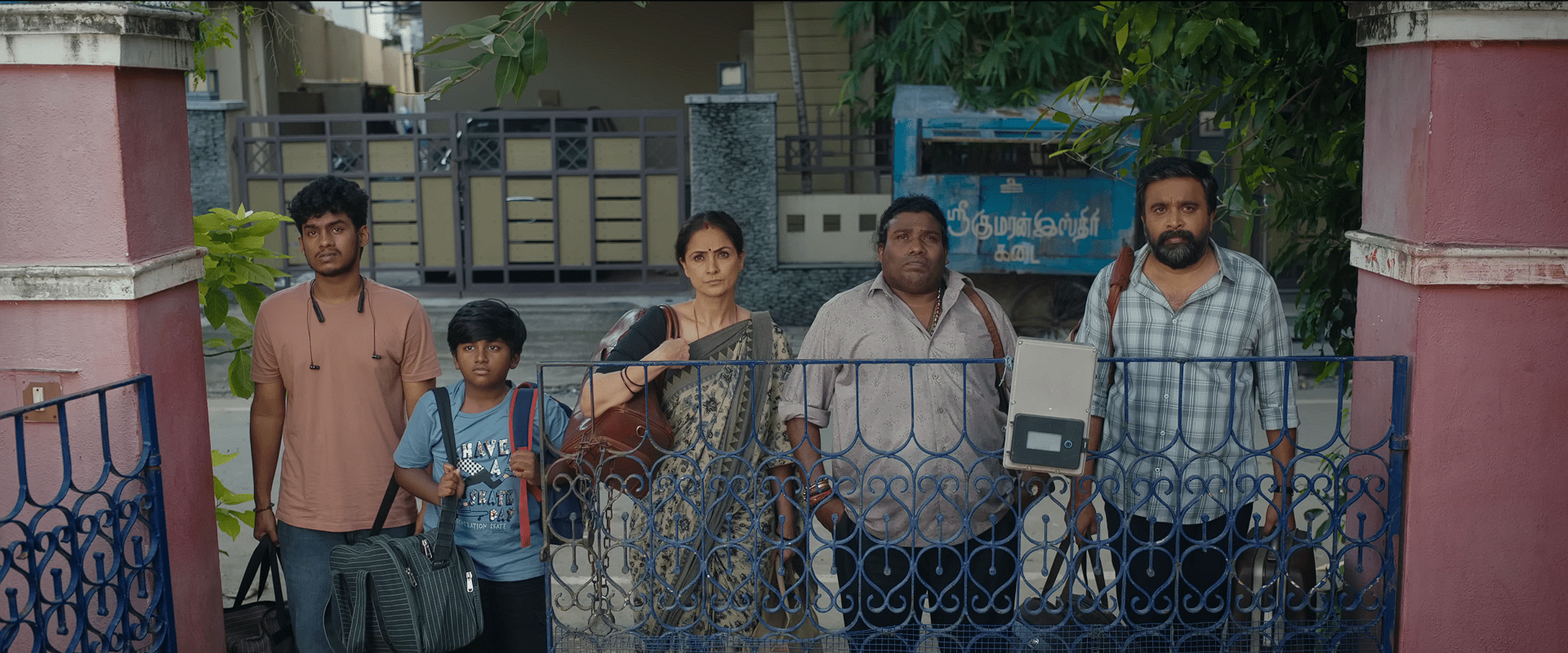
The story begins on the shores of Rameswaram, where a Sri Lankan refugee family – father, mother, and two small children – arrives with quiet desperation. Their reason for escape is rooted in economic collapse; as the film states, “due to the economic problems there, the cost of living has increased a lot… they couldn’t live there bearing that cost.” With survival in their homeland becoming unbearable, their journey towards India feels less like a choice and more like a last attempt at dignity.

Since they arrive without legal documentation, the family resorts to creating fake Indian identity papers. Despite their illegal entry, life initially moves peacefully – jobs come easily, a house is found, and the children are admitted to school without much struggle. This early portion of the film is clearly designed to establish hope, showing the family’s attempt to rebuild life stone by stone.
But just as that calm begins to settle, we are told that “for that peaceful life, a threatening incident happens.” The film positions this event as its turning point, although its eventual impact feels far less intense than the build-up promises.
A Familiar Template, But a Missing Foundation
One thought kept returning to me while watching Tourist Family: the influence of Ayothi on Sasikumar’s choice to take up this film is undeniable. The makers themselves seem conscious of this comparison, because the narrative echoes the same emotional blueprint – a struggling Sri Lankan family, an Indian man offering help, and a journey steeped in empathy.
However, the crucial distinction is that Ayothi had a deeply compelling and organic reason for the family’s suffering. There was death, helplessness, and a ticking emotional clock. Every obstacle felt necessary and rooted in reality.
Here, the motivation is softer, far less urgent. Economic hardship is mentioned, but it never escalates into a convincingly dire reason to flee one’s country illegally. As I watched, I found myself wanting something more layered – perhaps a glimpse into their desperation, or a moment where danger becomes palpable. Without that foundation, their journey lacks gravity.
Even after they arrive in India, their struggles remain unusually convenient. Jobs fall into place, housing is secured easily, and even the supposed tension of living without real documents is neutralised when they end up renting a room in the house of a police officer who is introduced as “a smiling police officer.” The film suggests that we should feel nervous that they might get caught, but the officer himself diffuses all tension with his soft, warm demeanour. The result is a narrative without grip, without urgency.
When Realism Gives Way to Staged Convenience
One of the recurring problems throughout the film is its noticeably “cooked up” feel – scenes appear designed more to push the story forward than to arise naturally from character motivations. A good example is the poisoning subplot, which is spread across four scenes but feels neither organic nor compelling. Similarly, the lengthy search sequence overstays its welcome, stretching tension until it dissipates instead of intensifying.

This is where the film most visibly struggles: it frequently steps beyond natural logic, sacrificing authenticity for convenience. Had the writing embraced a more grounded approach, Tourist Family might have delivered a more immersive theatrical experience. Instead, it occasionally feels like watching a staged play where the emotional beats are performed rather than lived.
Moments That Work: Comedy, Warmth, and Small Joys
Despite its narrative shortcomings, Tourist Family is not without charm. The filmmakers openly acknowledge through a title card that “Sri Lankan Tamil need not be fully used because not everyone will understand,” choosing instead to employ simpler Tamil while using Sri Lankan dialects sparingly for humour. Surprisingly, this strategy works. Some of the comedic moments land effectively, particularly those built around linguistic quirks.
The early scenes involving the youngest child are genuinely endearing, offering flashes of innocence that feel heartfelt. The terrace sequence where the family catches a thief brings an enjoyable burst of energy. Likewise, the subplot involving Sasikumar’s son dealing with a failed romance – culminating in the girl’s marriage – adds lightness and relatability.
These small moments remind us of what the film could have been if its emotional core had been stronger.

A Feel-Good Film That Doesn’t Fully Connect
The makers clearly intended Tourist Family to be a feel-good film, and in patches, they achieve that tone. But because “the entire story is unnatural, we couldn’t connect with the film fully,” and that sentiment lingered with me long after the credits rolled. The emotional beats feel strained, the stakes too low, and the narrative too stretched.
Final Verdict
Tourist Family is a film with heart, sincerity, and scattered moments of charm. But the lack of narrative realism and a weak central conflict make it difficult to emotionally invest in the family’s journey. With tighter writing and more grounded motivations, this could have been a powerful human story. As it stands now, it remains a pleasant but forgettable viewing experience.
Rating: 2.5/5