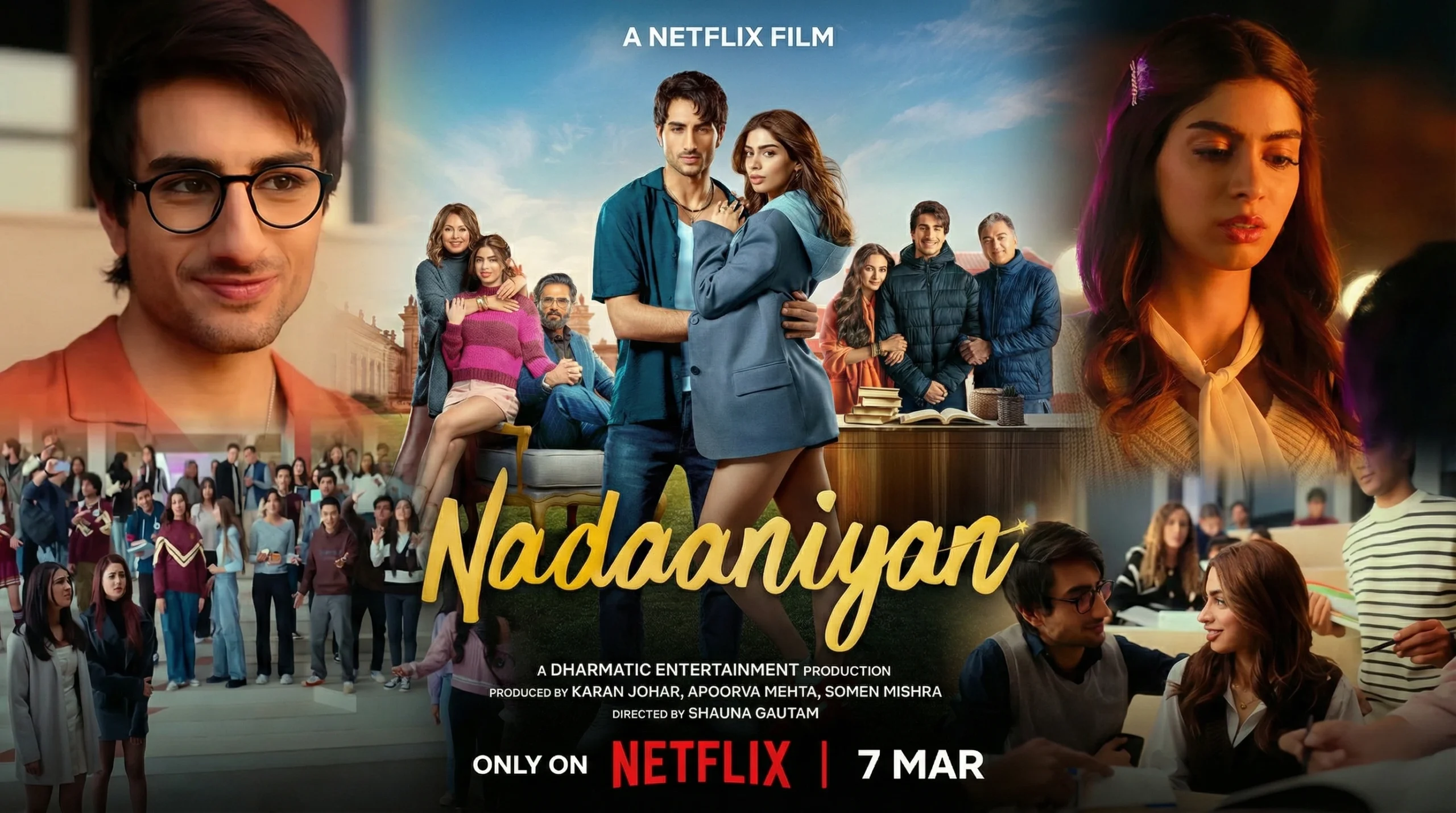
When I sat down to watch Nadaaniyan, the first thing that instinctively came to my mind was an involuntary sigh – “another nepotism movie has come.” It is not a statement of hatred, nor the beginning of a judgmental rant. It was simply the truth of the scenario. The film marks the debut – or at least what appears to be the debut – of Saif Ali Khan’s son, though I admit I no longer keep daily track of who is entering the industry, who is preparing for a launch, or what grand strategy is happening behind the scenes. Opposite him stands the film’s lead actress – the sister of Janhvi Kapoor, daughter of Sridevi and Boney Kapoor. If anyone were to accuse me of bias for pointing this out, I would still say it plainly: this is the environment the film arrives in.
Yet, as I often remind myself, children cannot choose the homes they are born into. And if I end up critiquing their work harshly, it is not because their parents are industry figures. The same standard was never thrown at Ranbir or Shraddha during Tu Jhoothi Main Makkaar. We judged them purely on acting because we know they have proven their talent repeatedly. Here too, I wanted to do the same – go in neutral, go in hopeful, and go in open-minded.
A Surprisingly Intelligent Meta Opening… and the Shock That Follows
Truthfully, I did not have many expectations from the lead actress because I had already seen her in two previous projects. But every time I watch a film whose teaser or trailer I skip deliberately, I enjoy walking in with a blank slate. Sometimes, surprise is a beautiful thing. And for a moment, I genuinely thought Nadaaniyan might surprise me.
The film opens on a line that instantly made me freeze and rewind. I paused the movie, locked the door, removed all distractions, and decided that if the film was starting like this, I needed to give it my full attention. And the line that made me do this was delivered by the “white-noising” protagonist, who says:
“If you look from outside, I look like the poster princess of privilege and entitlement. But from inside – why would you look from inside? You’ve already judged.”
It was clear from that moment that the film was going for meta commentary, breaking the barrier between screenplay and societal perception. The line wasn’t written for the character – it was written for the actor. A pre-emptive defence, a gentle reminder to critics and audiences that she is judged long before she speaks a dialogue. And because the film directly addressed that privilege debate upfront, I believed it was going to be sharply self-aware, intelligently crafted, maybe even bold.
If only that moment had lasted.
- A Surprisingly Intelligent Meta Opening… and the Shock That Follows
- The Shock of Poor Craftsmanship: ADR, Dialogue, and Delivery
- The Outlandish Fake-Boyfriend Plot
- The Acting – Painfully Inconsistent and Often Unbearable
- The Experience of Painfully Watching the Film – A Personal Breakdown
- Third Film, Zero Growth – A Concerning Pattern
- Ibrahim Ali Khan – A Performance That Redefines Expectations (In the Wrong Way)
- Writing vs Performance: A Confusing Tug-of-War
- The Characters Are Supposed to Be 18 – But Nothing Matches That Reality
- A Surprisingly Serious Subplot – But Even That Cannot Save the Film
- A Dialogue That Made Me Pause in Confusion
- The Only Thing I Liked – The End Credits
- Final Verdict: Should You Watch Nadaaniyan?
The Shock of Poor Craftsmanship: ADR, Dialogue, and Delivery
Within the first five minutes, that optimism crashed spectacularly.
What followed was, without exaggeration, some of the most awkward ADR and unpolished dialogue delivery I have seen in a mainstream film in recent times. The dubbing didn’t match lip movements, tonal shifts were abrupt, and scenes felt as though the emotional temperature had been mismatched in post-production.
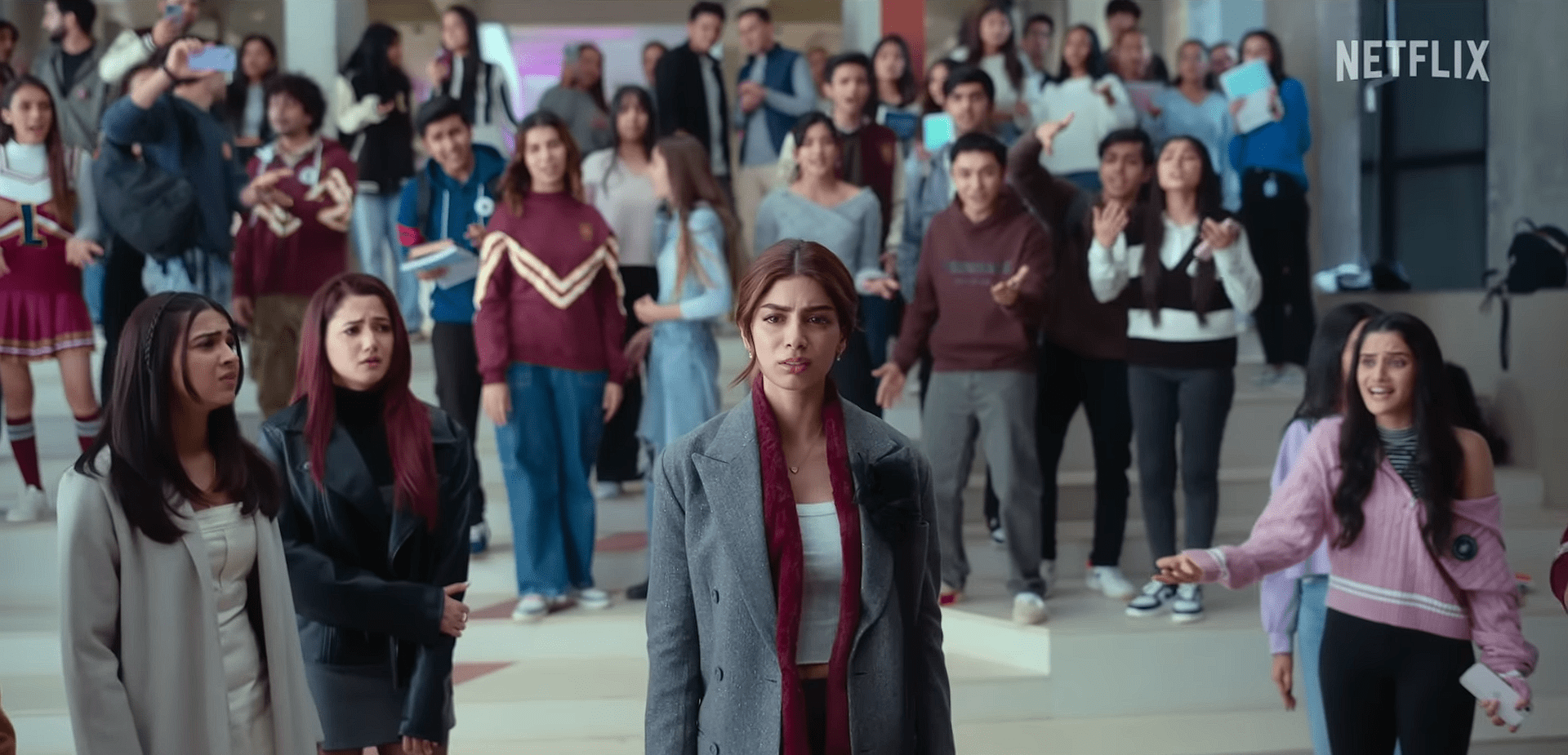
I felt like I was watching a modern Student of the Year–inspired universe – rich kids, rich school, glossy hallways, glamour at every corner – but unfortunately without the performance discipline required to hold such a setting together.

The plot moves into familiar territory: a persistent boy keeps messaging the protagonist, filling her DMs with long emotional texts. Her best friend – who also likes the boy – misunderstands the situation. Instead of clarifying, the protagonist chooses a truly baffling route.
And then arrives one of the defining cinematic choices of Nadaaniyan.
The Outlandish Fake-Boyfriend Plot
In a school full of privileged teenagers, one boy stands out: the lone middle-class student. Good in sports, good in studies, six-pack abs, conventionally good-looking – a perfect contrast to the glossy chaos around him. The protagonist approaches him and says she will pay him ₹25,000 a week to act as her fake boyfriend.
But not to actually pretend in a relationship – only to appear with her in photos where his face isn’t visible. She wants mystery, gossip, and suspicion to rise among her group so she can avoid a misunderstanding with the messaging boy.
Birthday meetings, posed photographs, a carefully crafted illusion – all as a defence mechanism for a situation that could have been solved with a single honest conversation.
To be fair, perhaps young audiences studying in high-profile schools may find this glamorous, aspirational, or entertaining. But beneath all that glitter, a major issue keeps rising again and again:
The Acting – Painfully Inconsistent and Often Unbearable
And this is where the film loses not just its grip, but its very foundation. Both main leads deliver performances so flat, so mismatched, and so tonally confused that I genuinely felt a headache forming midway.
Some bad acting is funny – it becomes unintentionally entertaining, like over-the-top films of earlier decades. But Nadaaniyan is not even enjoyably bad. It is exhaustingly bad.
The dialogue delivery is choppy, robotic, and often makes scenes feel like parodies of commercial advertisements. A sample exchange in the film goes something like:
“All Bright School.”
“You can apply for scholarship in All Bright School.”
“Yes, All Bright School scholarship.”
When actors sound like automated GPS instructions, emotional scenes collapse. And collapse they do, repeatedly.

The Experience of Painfully Watching the Film – A Personal Breakdown
At around the 15-minute mark, I felt I could not continue. I paused the film – only to realise that just fifteen minutes had gone by. In a two-hour movie, this was a daunting revelation. I needed an emotional recharge, so I went and watched episodes of Birth of the Movements of the Earth. I needed something extraordinary, something artistic, something with real craft to survive the experience.
It took me two full days to finish Nadaaniyan.
I have watched hundreds of films across languages, genres, and decades – yet very few have made me take a mid-film break for self-preservation. This one did.
Third Film, Zero Growth – A Concerning Pattern
This happens to be the lead actress Khushi Kapoor’s third film, after The Archies and Loveyapa. And ironically, after watching Nadaaniyan, her previous films now seem “okay” in comparison. If this level of acting qualifies one for three major projects, I cannot imagine the sheer frustration of talented newcomers who never get even half the opportunity or budget.
In Loveyapa, she played a middle-class girl but still felt too elite for the role. Here, she plays a rich girl but struggles equally. The dialogue delivery is so rough and inconsistent that it becomes hard to understand whether the issue is the writing or the acting.
Ibrahim Ali Khan – A Performance That Redefines Expectations (In the Wrong Way)
And then comes the debut performance of Saif Ali Khan’s son Ibrahim Ali Khan, which, without exaggeration, made me reconsider my earlier criticism of the lead actress. At least she had moments of slight emotional resonance. His performance, however, is so painfully raw and unpolished that I genuinely felt I needed money – compensation – for sitting through it. Everyone who manages to finish this film deserves to be paid.
The character he plays is supposed to be an all-round superstar student: the best in sports, swimming champion, debate team prodigy, academic high-achiever. Yet in one unintentionally comedic moment during a debate captain discussion, he simply lifts his shirt, reveals his six-pack, and declares: “Captain.”
And shockingly, the film treats this as a serious moment.
This is the middle-class character who is meant to teach humility to the privileged? Ironically, the actors themselves probably grew up in elite environments – yet cannot convincingly portray them.

Writing vs Performance: A Confusing Tug-of-War
At many moments, I genuinely wondered: is the writing absurd, or is the acting so weak that even sensible writing feels absurd? The emotional beats, the dramatic scenes, the introspective moments – everything collapses the moment a character opens their mouth.
And after watching Saif’s son, my respect automatically increased for the lead actress. After watching both, I found newfound admiration for Arjun Kapoor. Truly, if two or three more actors of this performance level enter the industry, Arjun Kapoor’s career will skyrocket automatically.
The Characters Are Supposed to Be 18 – But Nothing Matches That Reality
A fact that constantly caused cognitive dissonance was the film’s insistence that these characters are studying in 12th grade. They are supposed to be eighteen years old. But none of the actors, dialogues, behaviour patterns, or emotional maturity levels match that age bracket. The illusion collapses instantly.
A Surprisingly Serious Subplot – But Even That Cannot Save the Film
Beyond the glossy school drama, the film introduces another track about an unprivileged female character and her troubled family. Her father ends up impregnating someone else later in the film. It had the potential to create a layered emotional contrast – privilege vs struggle, illusion vs reality – but the acting dissolves whatever emotional weight the writing attempts to build.
To my own surprise, the later half of the film (which I watched on the second day) didn’t feel as aggressively bad. Maybe I had accepted my fate. Maybe I had surrendered to the suffering. Or maybe the emotional scenes – though poorly acted – were backed by music strong enough to create momentary impact.
But every time someone starts speaking, the illusion shatters.
A Dialogue That Made Me Pause in Confusion
Toward the end, a female character says:
“There is some saying that ‘there is no life without a man’, but the truth is the exact opposite.”
What does that even mean?
Is she saying:
- “There is no life with a man”?
- Or “There is life without a man”?
The intention was empowerment. The execution was confusion.
The Only Thing I Liked – The End Credits
After nearly two hours of emotional exhaustion, frustration, confusion, irritation, and occasional accidental comedy, the one moment that genuinely made me smile was during the end credits.
Not because the film was over – I had already passed the point of caring. I had endured the pain, embraced it, and accepted it. But the end credits were genuinely respectful. They didn’t just show names – they included photographs of various crew members, not just directors, producers, and actors, but editors, colorists, accountants, music engineers, and more.
It was the only moment where I felt the film honoured the people who truly worked behind it.
Final Verdict: Should You Watch Nadaaniyan?
Absolutely not.
By mistake, do not watch Nadaaniyan. Not even out of curiosity, irony, or boredom. Instead, if Superboys of Malegaon plays near you, watch that. Because weeks later, when social media fills with posts saying, “Wish I had watched it in theatre,” you will feel proud you made the right choice.
Rating: 1/5
Nadaaniyan had an intriguing meta start, but everything afterward collapses under poor acting, weak execution, and unintentional comedy. The glossy surface cannot hide the emptiness underneath.