Some films arrive with a premise so inherently rich that I expect the screenplay to blossom almost effortlessly. Love Marriage, directed by Shanmuga Priyan, is one such film – a story template that has succeeded across multiple languages, built on the chaos, comedy, and emotional upheaval that naturally spring from the great Indian marriage process. Yet, what surprised me while watching Love Marriage was not the story itself but how a plot brimming with potential could be handled so flatly that its innate charm rarely surfaces.
A Story Rooted in Familiar Chaos
The film revolves around a 33-year-old unmarried protagonist who has become something of a curiosity – and even a target – in his own village. People question him relentlessly: “Still you haven’t got married yet? Why?” The situation becomes so absurd that villagers even threaten to kill him if he refuses to marry. He simply declares, “I won’t ever get married,” and that stubbornness defines the early stretch of his character.

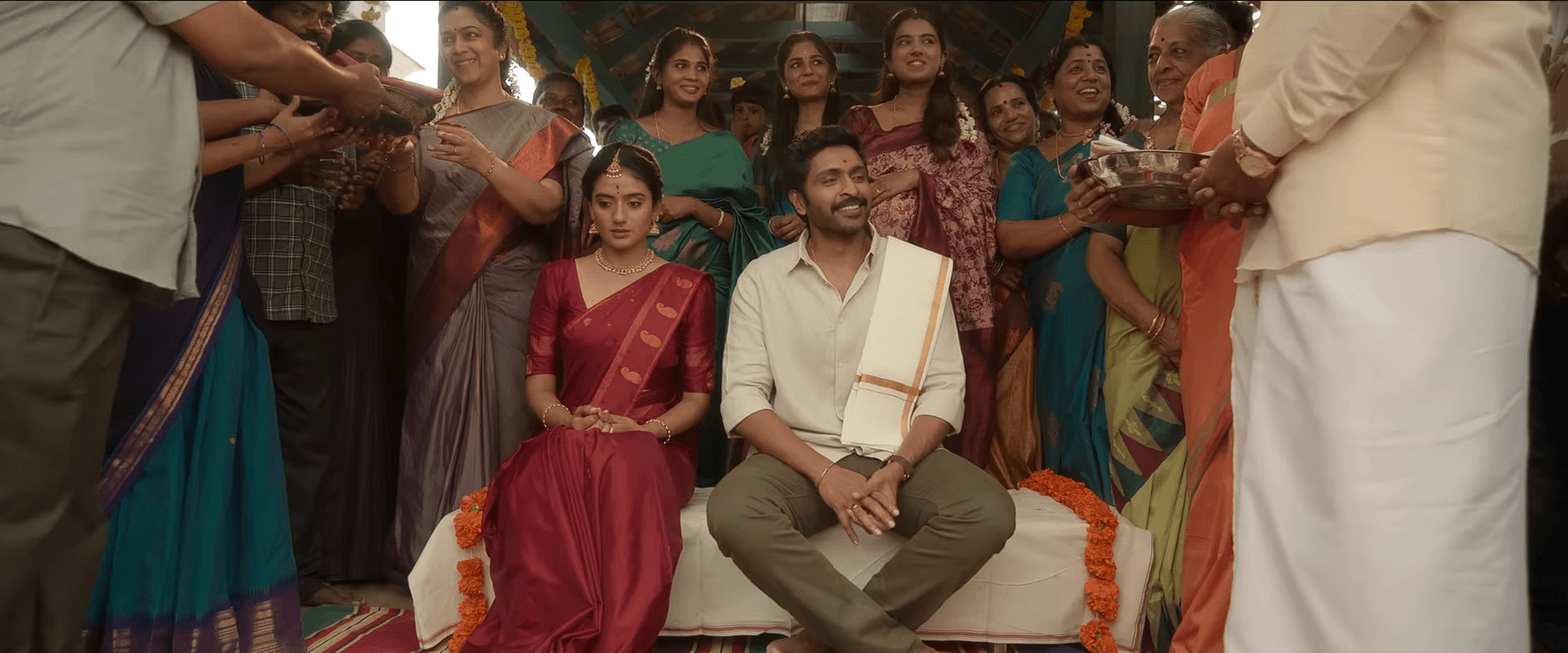
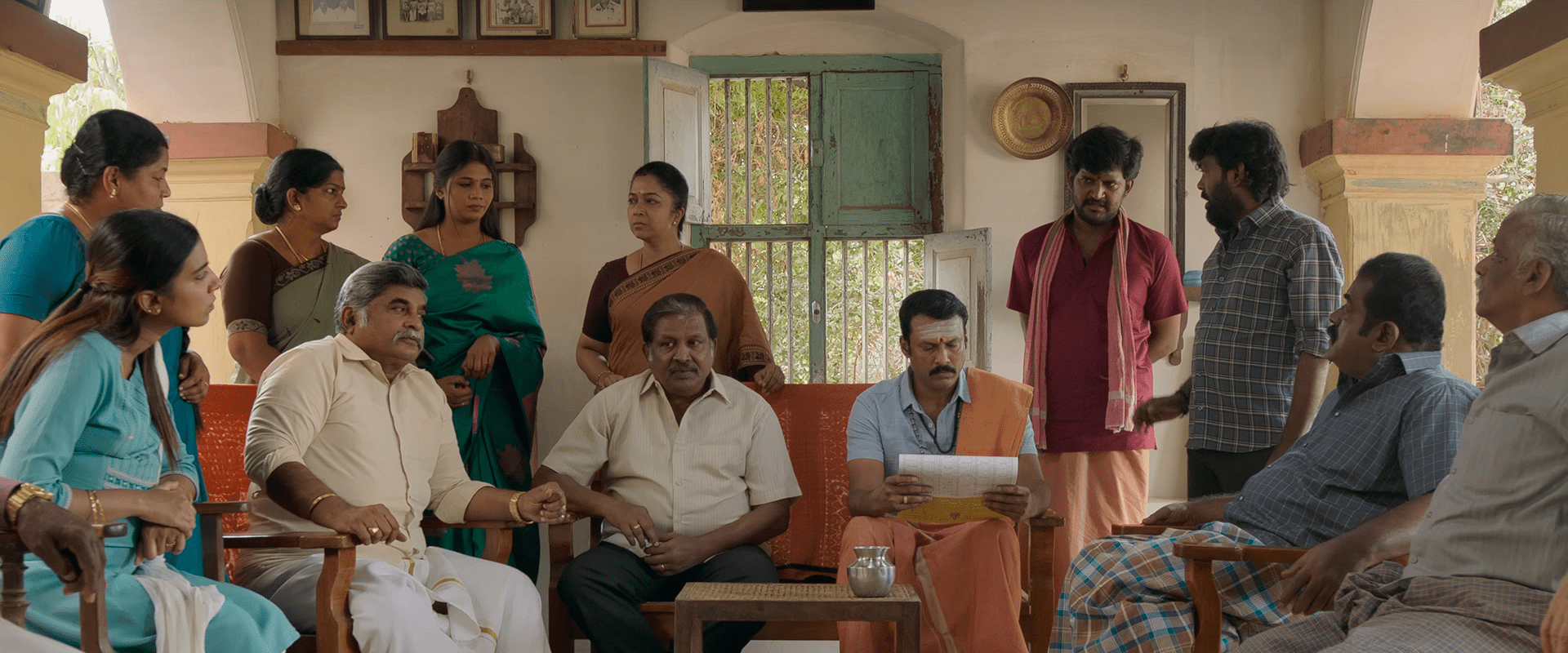
Ironically, though he himself is disinterested, circumstances push the families to find him a bride. Soon, the entire clan boards a bus, travelling to another town to meet a potential match. In typical Indian wedding style, the entourage includes relatives of every scale: elders, cousins, uncles, aunts – everyone armed with opinions. The hero’s family meets the girl, approves her without hesitation, and seals the engagement the very same day. The pacing is brisk, almost rushed, but still acceptable considering the genre.
The real twist arrives when, just as everyone prepares to head back home, a sudden announcement on TV declares the beginning of the Corona lockdown. The families are stranded. Travel becomes impossible. And what was expected to be a quick engagement trip turns into days of forced proximity, tension, and uncertainty.
The hero’s mother immediately panics, insisting they leave before something goes wrong: “If we stay here, some problem will occur and they will cancel the marriage.” Her concerns aren’t unfounded – wedding narratives thrive on unexpected conflict – but the hero dismisses her anxieties. Predictably, a problem does arise. The marriage gets called off. And the film tries to explore what leads to that cancellation and how the hero processes the emotional fallout.
Borrowed Framework, Missed Opportunities
Love Marriage is actually based on the Telugu film Ashoka Vanamlo Arjuna Kalyanam, a story framework that has been adapted successfully in several languages. The appeal of such stories lies in the rich events that happen between matchmaking and marriage – moments filled with comedy, tension, family dynamics, and small emotional beats that make the experience both relatable and entertaining.
In the best versions of such narratives, the film doesn’t need to chase twists. Life itself supplies enough drama: opinions clash, eccentric relatives stir chaos, secrets surface, and bonds deepen. The wedding house becomes a universe of its own.
But Love Marriage misses that magic almost entirely.

The biggest issue is the absence of interesting scenes. Not just fewer than expected – literally none that stand out. A wedding backdrop practically guarantees at least one memorable character or funny situation. Here, not a single supporting role receives proper development. The father-in-law, mother-in-law, friends, relatives – every figure who could have brightened the film remains untouched and underwritten.
A Weakly Designed Hero and a Surprisingly Strong Supporting Character
The script’s most damaging flaw lies in its protagonist. When the wedding collapses, the audience is supposed to sympathise with him. We should feel his pain, his frustration, his heartbreak. Instead, the character barely evokes anything. He never earns our affection. He doesn’t grow meaningfully. And he does little to anchor the emotional core of the film.
Unexpectedly, the only character who stands out is the bride’s younger sister. Her personality is the sole spark in an otherwise dull ensemble. Had she been given more scope, or had the film allowed her quirks to influence more moments, the narrative might have gained far more energy.

But with the hero remaining passive, and other characters barely present, the film struggles to hold emotional weight.
Execution That Feels More Like a TV Serial
A concept like this could easily have been transformed into a colourful, family-friendly entertainer if the makers had infused it with comedy, emotion, well-written songs, lively dances, or even a few unexpected twists. Instead, the entire execution feels surprisingly flat – almost like a long television serial episode rather than a theatrical film.
Scenes lack punch. Emotional beats remain undeveloped. Humour rarely lands. And despite the built-in chaos of being trapped during a lockdown, the film doesn’t take advantage of its situational potential.
The story itself is strong enough to serve as the backbone of a good film. But here, the treatment is so plain that the narrative’s natural vibrancy gets completely diluted.
Final Verdict
Love Marriage begins with a premise that should have made for an engaging, fun-filled, emotionally relatable film. But the lack of character development, absence of interesting scenes, and the hero’s weakly written arc drain the story of its charm. With better writing and a more energetic approach, this could have become a genuinely enjoyable family entertainer. Instead, it settles for being a flat adaptation that never utilises the strengths of its story.
Rating: 2/5