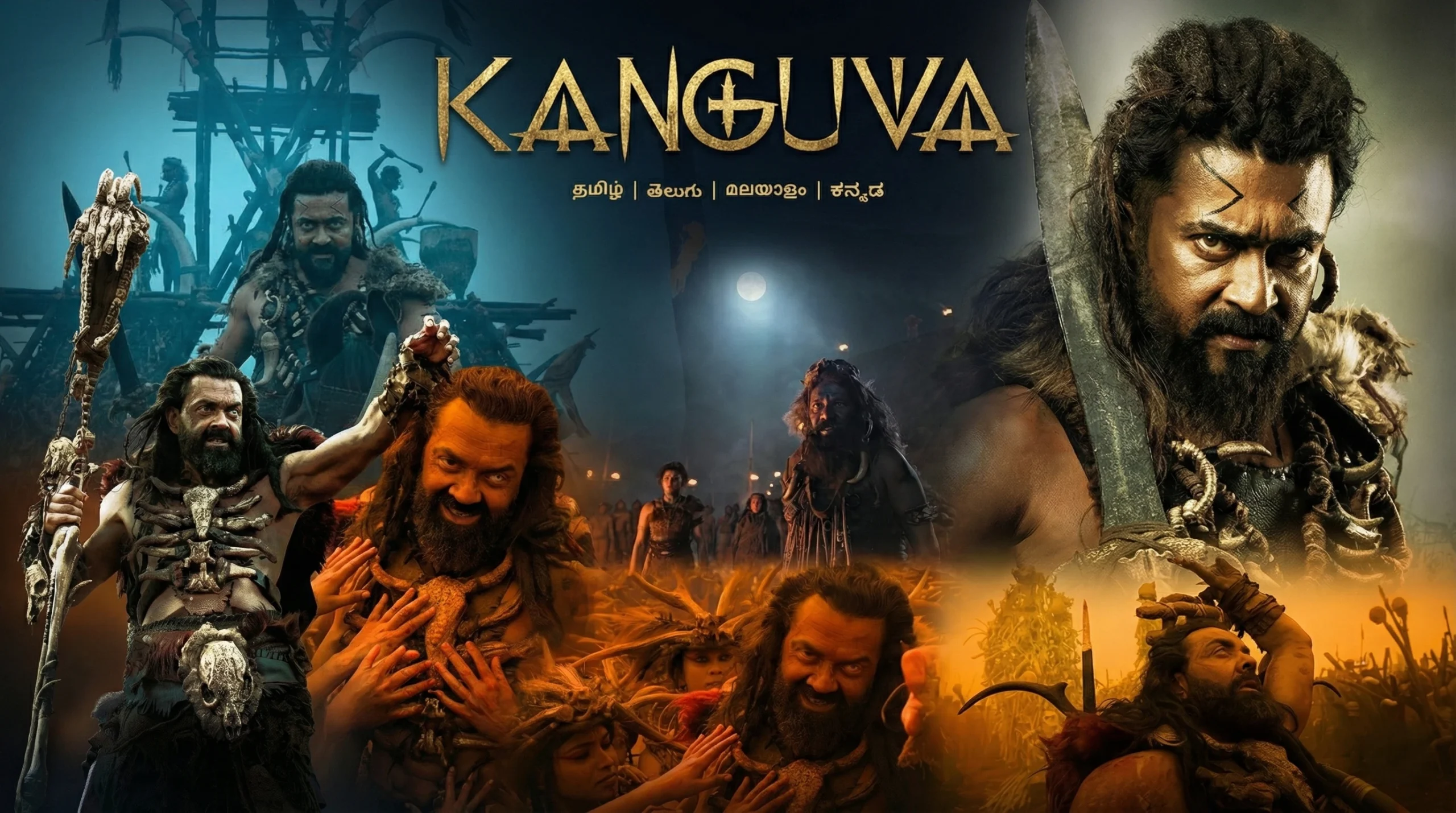
Surya and Bobby Deol’s latest film Kanguva has finally arrived in theaters. I went in with anticipation, brimming with excitement from the promotional material I had seen, and I walked out with more regret than satisfaction. There were only two moments when I was genuinely happy – two brief windows where I believed the film might actually deliver on its grand promise. The first was when they showed a small slice of the film’s early footage, a tantalizing montage of visual ambition. Then came the teaser and the trailers: the scale, the production design, the costumes, the colors, the dense and gritty locations, the towering sets – everything felt explosive. I was genuinely surprised that they were making a movie like this. Naturally, I became invested in the idea that I would be witnessing something cinematic, primal, barbaric, and unforgettable.
At a superficial level, Kanguva is built on a premise that many audiences today may not even enjoy – its setting is 1000 years ago, a time when life revolved around brutal simplicity. Human beings do not indulge in social-media style drama or witty monologues; instead, they live only to fulfill the basics: eat, sleep, protect themselves, fight, kill, and stay alive. Some viewers may dislike the idea instantly. I, however, was intrigued by this very element. I thought the film would show humanity at its most primal, stripped of sophistication, and amplify the instincts that shaped early civilizations. That relentless survival environment, that rawness, made me curious. Unfortunately, as time passed, I discovered how quickly my interest would crumble. My little fear – that some narrative limitations could ruin the film – turned out to be spectacularly accurate.
A Futuristic Opening That is More Silly Than Stylish
If you haven’t seen the posters or the latest trailer that popped up just two days before release, you’re in for a shock when the film begins. Because instead of immersing us in barbaric plains or tribal kingdoms, we’re greeted by something almost comically out-of-place: a secret government-like facility where experiments are being done on children. The sequence unfolds as if the movie was actually a biomedical sci-fi thriller. One boy manages to escape from this facility, reaching Goa, India, and there the story begins to pivot into 2024. It is at this moment we meet Surya – not the eternal warrior from a millennium ago, but a cool modern-day guy, your cinematic action-romance hero archetype.
There is also Disha Patani. Not as a mysterious scientist, not as a mentor, nor as a mythical being – just as the classic love interest and glossy modern heroine. The 2024 portion force-feeds us everything: staged fights, romantic interludes, flirty glances, and songs. And I must address a very particular moment. Weeks before the film’s release, I noticed a certificate from the censor board: they had cut around a 3-second clip from a song titled “YOLO – You Only Live Once” because of deep cleavage exposure. Naturally, I became curious. I wondered whether the YouTube version would be before the cut or after the cut.
Well, I got my answer the moment the song played inside the theater. As soon as it started, I was laser-focused. For better or worse, I did not blink. And gentlemen, let me report proudly: the film shows far more than the online promotional version. There are definitely extra scenes – scenes that exist only within the theatrical print. The film shows a yellow bikini and a blue bikini. Although I will confess I was sufficiently distracted to lose the continuity between costume changes.

Then comes the infamous censor moment – the exact part that was cut, the one piece from the song I had seen referenced in the board certificate. Let me be very clear: we will never know what that shot contained, who was in it, or how provocative it was. We see dancers. We see bikini shots of Disha. And yet the board decided that one particular piece had to go. The censored fragment exists in conversation and paperwork, not in the film itself.
- A Futuristic Opening That is More Silly Than Stylish
- The Dual Timeline: 2024 vs 1070 – One Is A Waste of Time
- A Clumsy Sci-Fi Aesthetic: AI Voices, Text-to-Speech, and Zero Logic
- The Big Screen Deception – 3D, VFX, and a Never-Ending Assault on the Audience
- Forced Humor and Internet References That Age Like Milk
- The Hindi Dub: A Catastrophe That Ruins the Film Beyond Repair
- Editing and Action: The Final Nails in the Coffin
- Final Thoughts – A Pan-India Misfire That Could’ve Been So Much More
The Dual Timeline: 2024 vs 1070 – One Is A Waste of Time
Leaving the bikini discourse aside, let us return to the actual structure of the movie. Kanguva is divided into two time frames: the present (2024) and the ancient past (1070). The modern-day chaos occupies the first 30–35–40 minutes. You sit there, watching montage after montage of futuristic laboratories, Goa beaches, romantic action beats, text messages, motorbikes, and nightclub scenes. Eventually the film takes a hard turn, finally transporting us into the year 1070. And from that point onwards, the entire film stays there almost until the final act. Then the narrative drags us back to 2024 toward the end. And let me tell you: by the time we returned, I felt like I had aged significantly. The film ate my hours like it was a hungry demon.
The tragedy of all this is that the story simply does not have the strength to sustain the weight of its own production. It is a reincarnation tale – ancient tribal kingdoms, five clans, one of which is Kangava. Surya in one life, Bobby Deol in another, tragedy, betrayal, present-day destiny. You know this template if you’ve watched any reincarnation blockbuster from India in the past two decades. And whatever happens in the present day? I would prefer to forget it altogether because nothing important actually happens. The film repeatedly sets up grand mythological stakes but returns to modernity like an exhausted student checking Instagram between revisions. It is a misuse of time.
To be fair, one specific idea is executed with some finesse: the concept of raising the son of the man you killed. The movie spends a considerable amount of time building emotional tension around that dynamic. But here’s the catch: the world around it is so poorly written, so weak in comparison, that even this moderately thoughtful idea appears exceptional. Not because it is genuinely great, but because everything else is so painfully mediocre that the slightest hint of novelty shines like a diamond in a garbage heap.

A Clumsy Sci-Fi Aesthetic: AI Voices, Text-to-Speech, and Zero Logic
The film dabbles with a few quirky experiments, especially in the early modern timeline. The use of AI-generated photos and videos is an example. It’s cute at first glance, perhaps even interesting. They even use robotic voices – text-to-speech style to portray a futuristic assistant. But the problem is painfully obvious: they show us an extremely advanced research facility, sophisticated genetic experiments, intricate biological tampering, and then the AI assistant sounds like a cheap mobile app from 2022.
This decision contradicts the film’s own internal logic. If the world is so technologically evolved that we can manipulate children’s neural patterns, genetically alter human evolution, and control memory systems, why does the AI sound like a free website? The entire setup becomes laughable. It’s not futuristic; it’s embarrassingly outdated. Visual ambition collapses beneath practical inconsistency.
The Big Screen Deception – 3D, VFX, and a Never-Ending Assault on the Audience
I watched Kanguva in a premium Hindi 3D screening. The theater wasn’t cutting corners; the glasses weren’t the cheap plastic ones – they were solid, comfortable, high-quality. And in the very beginning, when the film opens with an expansive landscape shot, I was genuinely impressed. The depth was excellent. The composition was beautiful. I thought: Wow, maybe this will redeem everything the trailers worried me about.
Sadly, that moment was a mirage. The visual effects in Kanguva are a constant cycle of hits and misses. When they work, they look good. When they fail, they fail miserably. The contrast levels often do not match. Characters appear with white silhouettes instead of black shadows. The edges look cut-out, like stickers pasted on a digital background. And in the name of 3D, the film repeatedly throws objects at your eyes: water, stones, leaves, arrows – every few minutes. Early on, it is amusing.
By the third repetition, it’s annoying. By the tenth, it becomes unbearable. Every 10–15 minutes something smacks your eyeballs from the screen. If there’s water anywhere in the shot, rest assured it will be launched toward your face. A river doesn’t flow; it attacks. A sword doesn’t clash; it lunges straight at you. After a while, I genuinely felt like removing the glasses and watching the movie in plain 2D. This wasn’t immersive cinema; it was a gimmick with no restraint.

Forced Humor and Internet References That Age Like Milk
Let us discuss another bizarre creative impulse. In the beginning, when Disha Patani appears, they attempt comedy. They toss in actual memes, TikTok-adjacent humor, even “Moe Moe” and The Boys references. It feels like the writers feared silence, so they stapled online jokes across the dialogues, hoping the audience would laugh purely because they recognized them. Instead of immersion, we get the cinematic equivalent of WhatsApp sticker packs.
The Hindi Dub: A Catastrophe That Ruins the Film Beyond Repair
Once the movie ended, I went back and watched the film’s trailer in its original language. It felt infinitely better. This Hindi dub is so bad, so intrusive, so mismatched to personalities and faces that it could be classified as sabotage. Take Surya, the hero with a double role. His voice simply does not suit the character at all. The voice actor may not be incompetent, but the tonal mismatch destroys any emotional connection. When your main hero sounds wrong, every supporting performance collapses around him like dominoes.
It gets worse. A couple of months ago the Hindi trailer dropped, and Bobby Deol’s voice was even worse. Thankfully – if “thankfully” is the right word – the film uses Bobby Deol’s own voice. His intimidating look, his world-building, the aura around him – excellent. And then he opens his mouth. The audio processing is so awful it feels like he recorded the dialogue using his phone’s voice memo and emailed it to the editor. They sprinkled bass all over it. The seriousness evaporates. The menace dissolves. Even dialogue that should have landed like thunder rolls across the theater like underwater echoes.
At two specific moments, Bobby Deol sounded like he was doing a terrible mimicry of Dharmendra. Unintentional, distracting, and unbelievable. This audio disaster alone sinks a large part of the movie’s emotional tension. It is clear that the Hindi version was an afterthought – an obligation, not a priority. A Pan-India film that neglects one of its largest audiences undermines its own potential.
Editing and Action: The Final Nails in the Coffin

As if the storytelling wasn’t weak enough, Kanguva’s editing actively harms its own experience. I’ll describe a particular example. The climax is unfolding. A character is hanging from somewhere, their life dangling in the hero’s hands. The villain punches the hero. Cut – immediately to the hanging character screaming. Then back to the hero delivering another blow. Then back to the screaming character. This repeats 10–15 times. Nothing changes in the situation. No development, no escalation, no tension. Just a visual loop.
The action choreography, too, adds no creativity. You expect something dynamic: edge-of-seat weapon work, imaginative tribal combat, maybe inventive uses of the terrain. Instead you get the generic playbook: take a sword, swing it, chop down 100 faceless enemies, wipe sweat dramatically. The movie uses the oldest trick – cutting away just before impact, then replaying the strike later in slow motion to look “cool.” These lazy techniques insult the film’s supposed epic status.
Final Thoughts – A Pan-India Misfire That Could’ve Been So Much More
There is a version of Kanguva that might work. That version, unquestionably, is the original Tamil cut. It is very likely that something about the language, the cadence, the emotional rhythm aligns better in the native performance. But the Hindi version? It is so bad that I cannot recommend it in good conscience. The weaknesses in dubbing, the audio quality, and the indifferent handling of dialogue are fatal. A film this grand cannot survive if its voice is severed from its body.
So who is Kanguva for? Only two kinds of people. First, viewers who want to see large-scale visuals on a big screen – handmade tribal costumes, brutal landscapes, towering kingdoms, massive raids, barbarian rituals. Second, people who want what is stereotyped as “South cinema” – mind-numbing hype moments, thunderous hero entries, temple chants of masculinity, invincible warriors. If you want that, then walk into the theatre, but keep expectations painfully low.
For everyone else, Kanguva is a disappointment. A visual feast with no soul. A powerful canvas with no painting. An epic ambition crushed under its own production.
Rating: 2/5