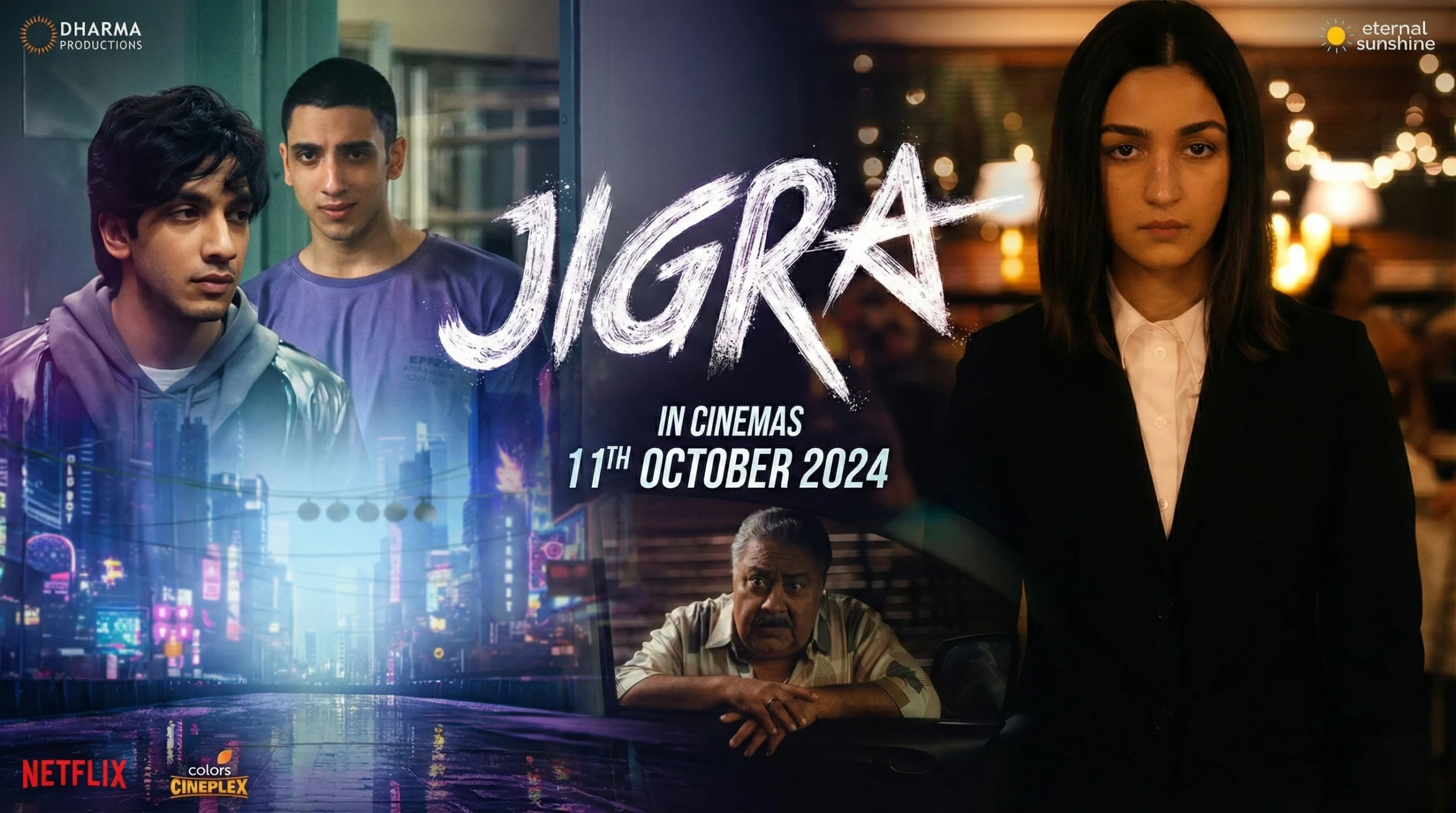
Alia Bhatt’s latest theatrical release, Jigra, arrives at a time when Bollywood has been searching for stories that go beyond standard emotional melodrama. If you’re planning to step inside a theatre this weekend and want to watch something rooted in intense personal relationships, this can genuinely be a solid option. But I’ll state this right away: not everyone will like it. This isn’t a film made to please all sections of the audience. It is a film built on instinct, obsession, and the kind of love that pushes a person to extremes. And because of that, Jigra becomes divisive by design.
Before I dig into my reactions, let’s address a key question many moviegoers ask: What is Jigra really about?
A Sibling Bond that Bends Logic and Morality
At its heart, Jigra is about two characters – a brother and a sister – and the intensity of their bond borders on obsessive passion. The older sister, Satya, played by Alia Bhatt, believes it is her absolute duty to protect her younger sibling. This responsibility isn’t temporary, nor is it something she outgrows. Whether he is a school-going child back home or now a grown man abroad, Satya’s instinct remains unchanged: protect him at any cost.
And she does mean at any cost.
The reason Satya is once again forced into protectiveness is almost absurd on paper. Her younger brother, Ankur, heads to another country, gets caught in some messy situation, and is ultimately arrested. The police there have little mercy. Within a month, they intend to kill him. So Satya moves from India to this foreign land and decides she will do the unthinkable: break him out of jail. Not appeal, not negotiate, not pray for good luck – she will tear the system apart and bring him home.
That’s the entire premise. Nothing more, nothing less.
At first glance, it may sound fantastical or impossible. But that’s where Jigra wins. In its two-and-a-half-hour runtime, the film commits to realism through sheer persistence. Almost 90 to 100 minutes of the film is devoted not to melodramatic flashbacks or long emotional speeches, but to the process of jailbreak itself – conception, strategic planning, failure, improvisation, and execution. It’s this detailed, grounded approach that makes what should be absurd suddenly feel believable.

Writing that Understands Humanity Over Stereotypes
One of Jigra’s biggest strengths is its writing. Bollywood thrillers tend to lean heavily on archetypes, especially when it comes to authority figures. Usually, the prison warden or chief jailer is a one-note villain – corrupt, sadistic, and placed there so the audience can justify violence against him in the climax. Jigra refuses to participate in this lazy storytelling.
The main jailer is not a caricature. From the rather subtle glove-changing moment introduced early in the film to the way he rigidly follows the prison’s rules, the character isn’t treated as a punching bag for brutality. Instead, he is a person, not just an obstacle. Watching this detail, I appreciated the nuance. The script doesn’t want you to cheer blindly; it wants you to understand everyone’s motivations.
This extends to the entire supporting cast. Each role has purpose and dimension; they don’t drift into the background. Manoj Pahwa, in particular, is a standout. He carries a surprising duality – sharp, intimidating when necessary, and unexpectedly hilarious when the moment allows. I watched Vicky Vidya Ka Woh Wala Video just eight hours earlier, and astonishingly, Jigra had more genuinely funny moments than that comedy. The moment Pahwa’s character pulls out a gun, shouting, “No one, no one – arre amazing!” remains one of the funniest beats in the film and a reminder that humor can exist even within heavy narratives when carried by the right actors.
Vedang Raina, who plays the younger brother, delivers a strong performance as well, though his character functions more as the emotional trigger for Satya. He is the reason she becomes who she becomes. And honestly, I don’t consider that a flaw. Jigra is designed to orbit Satya, not to share the narrative spotlight equally. The film depends on her emotional turbulence, and Alia Bhatt delivers on every front – emotionally unstable, ferocious, obsessively protective. It’s not a pretty performance; it’s a raw one.

Vasan Bala’s Filmmaking: Controlled Chaos, Not Random Rage
Director Vasan Bala, known previously for Mard Ko Dard Nahi Hota and Monica O My Darling, brings a startling confidence to Jigra. He makes creative choices that initially seem casual, only to reveal their weight later. The introduction of Satya exemplifies this. At first, you might assume she’s just another event-management professional living a regular life. Bala slowly adds fragments of information, until suddenly you realize, “Oh – she’s something else entirely.” This controlled revelation is one of the film’s best storytelling techniques.
The result is a world that feels lived-in – messy yet real, driven by human psychology rather than cinematic convenience. That’s why the jailbreak doesn’t feel like a superhero mission or a vigilante fantasy. It feels like the desperate, brutal attempt of someone who has nothing left to lose.
A Film that Rejects Moral Expectations
Here’s the point where Jigra becomes polarizing. This movie doesn’t care for morality. Satya will do anything – literally anything – to save her brother. If 10, 15, or 20 innocent people die along the way? She wouldn’t even blink. And I personally appreciate that approach. I don’t go to the movies to watch morality lessons. Films like Kabir Singh, Animal, or Arjun Reddy divide audiences for the same reason – their characters aren’t role models, and they never claim to be.

Satya makes her position extremely clear:
“When did I ever say I’m a good person? I’m just his sister.”
That one line sums up the soul of Jigra. If you need your protagonists to be ethically righteous, stay away. This is a film about emotional extremism, not moral redemption.
Action, Tension, and a Pacing that May Surprise You
If you walk in expecting nonstop action sequences, adjust your expectations. There is a solid roadside fight, and the final half hour – a full jailbreak – is thrilling and well executed. But everything before it is deliberate setup: strategy, attempts, failures, recalculation. The film is more about tension than action.
Personally, I had two complaints. First, some music choices felt overly dramatic. Not the actual soundtrack – the compositions themselves are excellent – but the timing of certain pieces didn’t land perfectly for me. There’s a brother-sister track that plays multiple times, and then a boat-sequence at the end. That moment felt unnecessary. Until that point, Bala keeps the film impressively realistic, and then in the final five minutes, he adds suspense elements that feel external rather than organic.
Visually, however, Jigra shines. Cinematography, lighting, and camera movement are striking. At times, some scenes felt overly dim in my theatre – could be a projection issue; could be intentional. If your screening felt dark too, you’re not alone.

Final Thoughts
Ultimately, Jigra delivered exactly what I expected – and perhaps slightly more. I walked into the theatre wanting a story of relentless sibling loyalty, and that’s precisely what I got. If the trailer intrigues you and you’re drawn to narratives about obsessive love, give this film a try. It may unsettle you, it may morally offend you, but it will not bore you.
Rating: 4/5