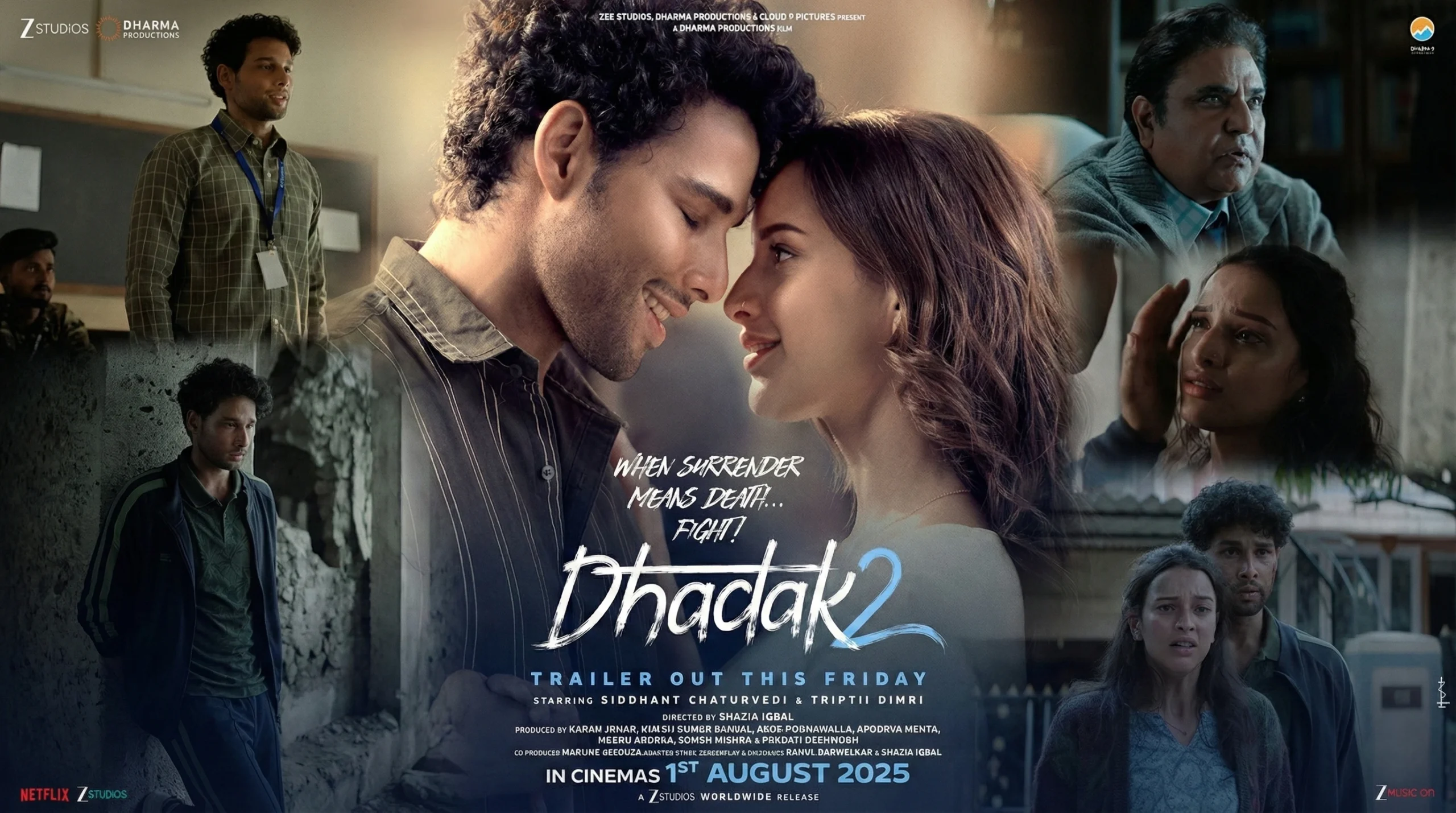
When I walked into the theatre for Dhadak 2, starring Triptii Dimri and Siddhant Chaturvedi, I was fully aware that the film carried the weight of its title. The original Dhadak had introduced Janhvi Kapoor to the industry, but beyond the name, there is absolutely no resemblance – neither in approach nor in tone. Dhadak 2 is a completely different beast, and technically it functions as a remake of the acclaimed 2018 Tamil film Pariyerum Perumal. Yet in its Hindi adaptation, the story finds a new voice, sharper edges, and a raw emotional intensity that hits with full force.
Over the past one to one-and-a-half months, I’ve sat through a dizzying variety of films – superhero spectacles, dinosaur dramas, car-racing extravaganzas, slapstick comedies, and mushy romances. But Dhadak 2 stands apart in a way few films this year have. It isn’t loud or showy. It isn’t trying to give you a temporary high. Instead, it’s serious, grounded, and emotionally wrenching. And within its quiet intensity lies its biggest triumph.
A World Built on Caste, Prejudice, and the Fear of Society
The entire narrative is anchored in one unshakeable theme – casteism and caste-based discrimination. There are no shortcuts. No sugarcoating. The film chooses to walk directly through the fire.
Siddhant Chaturvedi plays Neelesh, a young man who wants to become a lawyer. Why he carries that ambition is something the movie chooses to reveal slowly, layer by layer, and I will let the film do that work rather than spoil it here. What matters is that Nilesh enters a prestigious college through the quota system, and from the very beginning, his presence becomes a quiet reminder to others of the caste boundaries they believe should not be crossed.
In the same classroom sits Triptii Dimri’s Vidhi, who is also pursuing her degree. Their initial interactions are subtle, slow, and unforced – yet beneath the surface, the simmering tension of caste begins to shape their entire trajectory. Neelesh’s caste is constantly, almost casually, pointed out. And as he and Vidhi grow closer, what starts as a gentle friendship spirals into an explosive conflict because her family fears the one thing they cannot imagine compromising on: “What will society say?”
This fear escalates, poisoning every interaction. Day by day, things become more hostile, more dangerous, more suffocating. And the film raises several pressing questions: Will Neelesh be allowed to complete his law degree? Will he even survive the ordeal? Can his bond with Vidhi endure the crushing weight of caste politics?

And just when you think the film is focused solely on their love story, a chilling third layer enters the frame – a serial killer used like a ticking time bomb. He lurks in the background, appearing without warning, disrupting moments of peace, and heightening the dread. Saurabh Sachdeva plays this role so effectively that his presence alone is enough to tighten your chest. I’ve seen his work in Pushpa 2, Malik, and even Badass Ravi Kumar, but here he is on another level entirely.
- A World Built on Caste, Prejudice, and the Fear of Society
- Not the Most Unique Story on Paper – But Powerful in Execution
- Siddhant Chaturvedi’s Career-Best Performance
- Triptii Dimri Shines with Quiet Strength
- Direction That Hits Hard, Scenes That Stay With You
- A Few Minor Complaints – but Nothing Major
- A Surprising Burst of Humour – Delivered by an Unknown Hero
- The Ending – Painful, Thought-Provoking, and Slightly Unrealistic
- Final Thoughts – A Film That Deserves to Be Seen
Not the Most Unique Story on Paper – But Powerful in Execution
If I narrate the plot to you plainly, you might think you’ve seen films structured like this before. And to some extent, that might be true. But Dhadak 2 is not a film measured by its blueprint – it is measured by the way it tackles its emotional core. This is a film that refuses melodrama and rejects exaggeration. Instead, it opts for nuanced storytelling that allows the audience to think, reflect, and feel.
Scenes of oppression are not thrown at you dramatically. They are presented with such restraint that they become even more painful. And one of the smartest angles the film introduces is Nilesh’s internal conflict – he seems to be running away from his own identity. Multiple characters directly ask him: “What do you want?” Yes, he wants to become a lawyer. Yes, he wants to marry Vidhi. But beneath that is a deeper struggle – a desire to escape the identity society keeps forcing upon him. This layer enriches the storytelling immensely.
Siddhant Chaturvedi’s Career-Best Performance

Let me say this without hesitation – Siddhant Chaturvedi has delivered the finest performance of his career in Dhadak 2. This is the kind of role actors hope they get at least once in their lifetime. His fear, his desperation, his helplessness, and ultimately his fire – he portrays every shade with astonishing skill.
There’s a moment where he rises in near-heroic fashion, accompanied by an action-style background score. It’s a mass moment in a deeply serious film – and against all odds, it works beautifully.
This is the performance that makes you forget his last film entirely. In fact, I won’t even mention its name – I’ve erased it from my memory too.
Triptii Dimri Shines with Quiet Strength
Triptii Dimri’s role is quieter, more passive, and shaped by circumstances beyond her control. But she brings such emotional weight to her performance that the character of Vidhi never feels overshadowed. After Animal, she gained mainstream attention as a “national crush,” but those who watched Bulbbul and Qala already knew her immense potential. Dhadak 2 gives her space to prove it again.
Together, Siddhant and Triptii share a chemistry that isn’t loud or dreamy; it is rooted in fear, tenderness, and urgency. By the end, their bond feels deeply real – and that’s no small accomplishment.
Direction That Hits Hard, Scenes That Stay With You

Since this is a remake, I cannot judge how much has been recreated shot-by-shot. But I can say this – the direction is impactful. Scenes are set up with such precision that they land exactly where they need to. Information is revealed carefully, allowing tension to build naturally.
There are moments so intense they’re difficult to watch – like Neelesh clinging to a bench while three boys try to drag him away. These scenes don’t feel staged; they feel frighteningly real.
Even the production design deserves praise. Whether they built sets or shot on real locations, the environment feels painfully authentic. A poor household looks like a poor household – not a polished studio version. As someone who watches films weekly, I can say that authenticity has become a rarity worth appreciating.
A Few Minor Complaints – but Nothing Major
If I’m nitpicking, the first half is slightly slow. Only slightly. A tighter pace could have enhanced the emotional build-up even more.
And right before the interval, Siddhant has a phenomenal emotional scene where he breaks down. His acting is impeccable – but the sound mixing is not. His crying audio and the background music seem to clash rather than blend.
These are small issues in an otherwise solid film.
A Surprising Burst of Humour – Delivered by an Unknown Hero

There is a man who appears in only two scenes – maybe not even credited. When Neelesh is caught and brings along a “fake father,” this man’s performance had the entire audience laughing aloud. In a film this serious, pulling off intentional humor without breaking tone is an achievement. And he does it so well that even a full comedy film like Son of Sardaar would feel embarrassed.
The Ending – Painful, Thought-Provoking, and Slightly Unrealistic
As the film approached its final moments, I found myself wondering how the makers would choose to end it. Violence cannot solve the problem the film is addressing – so where would they go?
Then comes Triptii Dimri’s moment. A defining moment. And all I can say is: keep your headphones ready.
There is also a small scene after the credits begin. Personally, I feel the movie would have been stronger without it. But I understand the need for closure – especially when the story ends at such a raw point. One scene, involving a train track, requires you to interpret it yourself. The other feels painful, almost too painful, and slightly breaks away from the grounded realism the film had maintained. People simply do not change that fast in real life.
Final Thoughts – A Film That Deserves to Be Seen

Dhadak 2 surprised me in the best way possible. It is serious, impactful, emotionally gripping, and anchored by two career-defining performances. Siddhant Chaturvedi and Triptii Dimri elevate every frame they’re in, and the film’s thoughtful direction ensures that the message hits hard.
If you’re in the mood for something lighthearted, this isn’t for you. But if you want to watch a meaningful, well-made film that leaves you thinking long after the credits roll, then I genuinely recommend watching Dhadak 2. And if you do see it on my recommendation, come back and tell me how it felt.
Rating: 4/5
A powerful, emotionally charged drama that stands tall on performance, storytelling, and impact – despite a few minor flaws.