I stepped into Bun Butter Jam with a curiosity shaped by the film’s early chatter – whispers of tangled romances, exaggerated subplots, and a narrative style that apparently borrows more from daily soaps than from conventional cinema. What I found was exactly that: a movie that treats melodrama as its bloodstream and confusion as its favourite aesthetic. Directed by Raghav Mirdath, the film attempts to repackage the chaos of mega-serial storytelling into a big-screen format, and the result is a spectacle that is equal parts amusing and overwhelming.

A Familiar Premise Wrapped in an Overcrowded Story World
At its core, Bun Butter Jam begins with a charmingly simple set-up. The hero and heroine grow up in families that share a long-standing friendship. Their mothers, in particular, hold a hopeful vision – if these two youngsters fall in love and eventually marry, life will be pleasantly convenient and emotionally fulfilling for everyone involved. This parenting-by-nudging approach gives the film its initial humour, and I appreciated the attempt to show how parental expectations often shape, and sometimes distort, young relationships.
However, the plot swerves sharply the moment we learn that both leads are already in love with other people. What follows is a labyrinth of relationships – some secret, some intersecting, and some entirely unnecessary – unfolding at breakneck speed. The film embraces confusion not as an accident but almost as an identity. I found myself constantly piecing together who is connected with whom, and in many cases, why those connections even matter.

The writing hints at inspiration from the chaotic comedic sketches of Vivek, particularly the kind where characters rapidly reveal secret love affairs until no one – including the audience – can keep track. Bun Butter Jam seems determined to expand that comedy into a full-length narrative, though whether it successfully translates that humour is debatable.
A Mega-Serial Template Borrowed Without Restraint
One of the most striking qualities of Bun Butter Jam is how unapologetically it copies the structure of mega-serials. The film opens the door to well over a dozen characters, each with their own subplot, then proceeds to hop across them with complete unpredictability. I could almost imagine the screenplay being written depending on which actor showed up for the day.
The hero’s unseen lover, the friend’s parallel romance, the heroine’s boyfriend, Vikranth’s mysterious arc, the parents’ intertwined stories – every track gets introduced with promise but ends up feeling like a reel stitched into a larger reel. The storytelling rarely holds its ground long enough to build depth or emotional engagement.
In many moments, the film resembles the quick-edit Instagram relationship reels that aim for instant shock or sentimentality without any lasting impact. There is hype, there is energy, but hardly any nuance. The narrative keeps piling up incidents without taking the time to justify them or to explore their dramatic potential.

A Comedy of Confusions That Slips Into Excess
As I watched the film escalate into a web of affairs and half-secrets, I couldn’t help but think how close it stood to becoming a full-blown parody of itself. The director clearly knows the tropes of melodrama – the clandestine romances, the misunderstandings, the one-sided admirers – but instead of sharpening them for cinematic effect, he throws them into a blender.
There’s a point in the story where I realised that almost every character is romantically entangled with at least two others, directly or indirectly. The hero hides one love, his rival fights for another, a third character secretly pines for the same woman, while yet another subplot reveals an additional clandestine affair. The film tries to juggle all of this with comedic flair, but the jokes land inconsistently because the emotional stakes remain thin.
The writing mocks its own complexity at times, and I found that self-awareness refreshing, yet it doesn’t go far enough to justify the clutter. Instead, the plot continues to spiral, eventually pushing the film dangerously close to becoming what many would call a “Kilma-style” over-the-top drama.

Character Arcs Without Direction
In a story bursting with characters, one would expect at least a few strong emotional anchors. Unfortunately, the film denies itself that stability. The parents’ track, which should have grounded the narrative, becomes another exaggerated subplot that raises more questions than it answers. Their reactions to their children’s relationships feel inconsistent, almost as if rewritten scene by scene.
Even the lead pair suffers from underdeveloped motivations. Their romantic complications could have been a compelling commentary on parental pressure and youthful autonomy, but the screenplay rushes through every emotional beat. I kept wishing the film would slow down, breathe, and invest in its core story – because somewhere beneath the mess, there is a worthwhile premise.
A Film That Needed Discipline More Than Drama
The real disappointment of Bun Butter Jam lies not in its ambition but in the lack of narrative discipline. Had the storytelling been tightened and the subplots pruned, the film could have delivered an enjoyable romantic comedy infused with satire. Instead, it opts for an overloaded drama that never fully decides whether it wants to entertain or parody the genre.
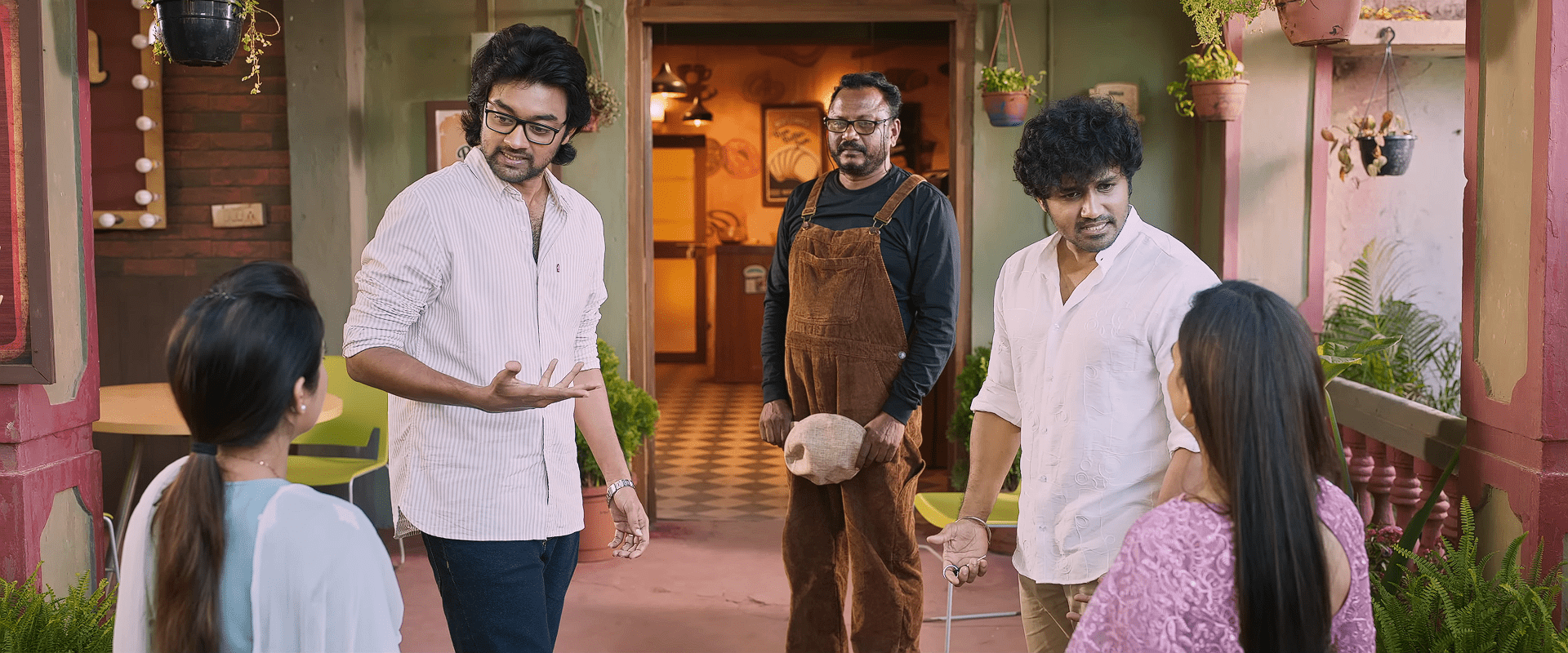
There are sparks of humour that genuinely work, and some character moments are delightfully quirky. But the overwhelming clutter overshadows these strengths. The film’s confusion becomes its most defining feature – something that could have been cleverly used but is instead allowed to run wild.
Final Verdict
Bun Butter Jam is a chaotic mega-serial served in film format – sometimes funny, occasionally engaging, but mostly weighed down by its own excess. It has ideas, energy, and ambition, but lacks the cohesion required to turn them into a satisfying cinematic experience.
Rating: 2 out of 5